On March 28, 2026, Sound Transit's 2 Line finished something the lake had never allowed before: a rail line running under and across Lake Washington, 14 miles and 10 stations connecting Seattle to Mercer Island, Bellevue and Redmond. For the first time in the region's history, someone living three blocks from the water in Madison Park could reach downtown Bellevue without a car, a bridge toll, or a bus transfer.
If the price gap between Seattle's lakefront neighborhoods and the Eastside's waterfront enclaves was ever really a toll on the drive, this was the year it should have started to close. Five months in, it hasn't. The medians on either shore look almost exactly like they did before the trains started running, and the reason has less to do with commute time than with two things no train can touch: a school district boundary and a shoreline ordinance.
A Lake With Two Price Tags
Zoom out from the water and the gap is already visible. King County's May 2026 NWMLS breakout put Seattle's combined residential and condo median at $899,975, against $1,337,500 for the Eastside, a spread wide enough that agents on both sides describe it as a structural premium rather than a market mood. That premium runs 10 to 25 percent depending on which Eastside city you compare Seattle to, and it has held even as Seattle's price grew faster year over year than the Eastside's did in that same window.
Narrow the view to the water itself and the gap gets larger, not smaller. Seattle's lakefront neighborhoods, Madison Park, Denny-Blaine, Laurelhurst, sit on the west shore facing east across the lake toward Bellevue and the Cascades. The Eastside's waterfront enclaves, Yarrow Point and Medina, sit on the east shore facing west toward Seattle and the Olympics. Same lake, same water, same commute distance now that rail runs both directions. Different price entirely.
What a Waterfront Dollar Buys, Shore by Shore
| Neighborhood | Shore | Recent median | What the number reflects |
|---|---|---|---|
| Madison Park | Seattle | $2,196,750, all home types, up 14.7% year over year as of July 2026 | 17-day median time on market, walkable village core, Seattle Public Schools |
| Denny-Blaine ("the Gold Coast") | Seattle | $3,087,500 for single-family homes sold in the trailing six months of 2026 | About one sale a month, low-bank estates near the Seattle Tennis Club |
| Yarrow Point | Eastside | Roughly $7.5 to $7.8 million residential median in spring 2026, on a sample of just a few closings | Unincorporated King County rules, price range spanning $2.5M to $15M+ |
| Medina | Eastside | $5.29 million median list price for waterfront listings as of July 2026 | Shoreline Master Program governs anything within 200 feet of the water |
Every one of these figures comes from a market where four or five closings a quarter is normal, so a single high-end sale can move the median by hundreds of thousands of dollars. That volatility is real, but it doesn't erase the pattern underneath it. The Eastside figures here are higher than Seattle's, though the comparison includes both sale and listing medians.
The Premium Isn't a Commute Toll
Here is the piece that gets missed when buyers frame this as Seattle versus Bellevue: the Eastside premium tracks school district boundaries almost as tightly as it tracks the water. Bellevue, Lake Washington and Issaquah school districts sit entirely east of the lake. None of them cross into Seattle. Homes zoned into Bellevue School District have been trading 8 to 12 percent above comparable homes in adjacent non-BSD neighborhoods, a gap that shows up consistently in transaction data rather than as an occasional outlier.
That is a premium buyers are paying for a boundary line, not a bridge crossing. A 2 Line station a five-minute walk from your door doesn't change the school-district boundary between Medina and Madison Park. Rail solved the commute problem. It left the enrollment problem exactly where it was.
The Other Half of the Premium Lives in the Shoreline Code
The second mechanism is more local and, for a market this thin, arguably more decisive. Medina is an incorporated city, and any development within 200 feet of the ordinary high-water mark on Lake Washington falls under its Shoreline Master Program, layered on top of standard zoning. That adds real friction and real time to any waterfront project, and it keeps Medina's inventory small, gated, and slow to turn over even by Eastside standards.
Yarrow Point sits on the same lake. Waterfront in Yarrow Point has been trading at roughly 60 to 70 percent of comparable Medina waterfront. Buyers who get priced out of Medina often land in Yarrow Point specifically because of this gap, and the town's own waterfront-to-interior premium runs a narrower 80 to 140 percent, versus 150 to 250 percent in Medina.
None of that shows up on a median-price chart. It shows up in permit timelines, in how long a listing sits, and in which town a builder chooses to compete in first.
Two Kinds of Water, Not Just Two Price Tags
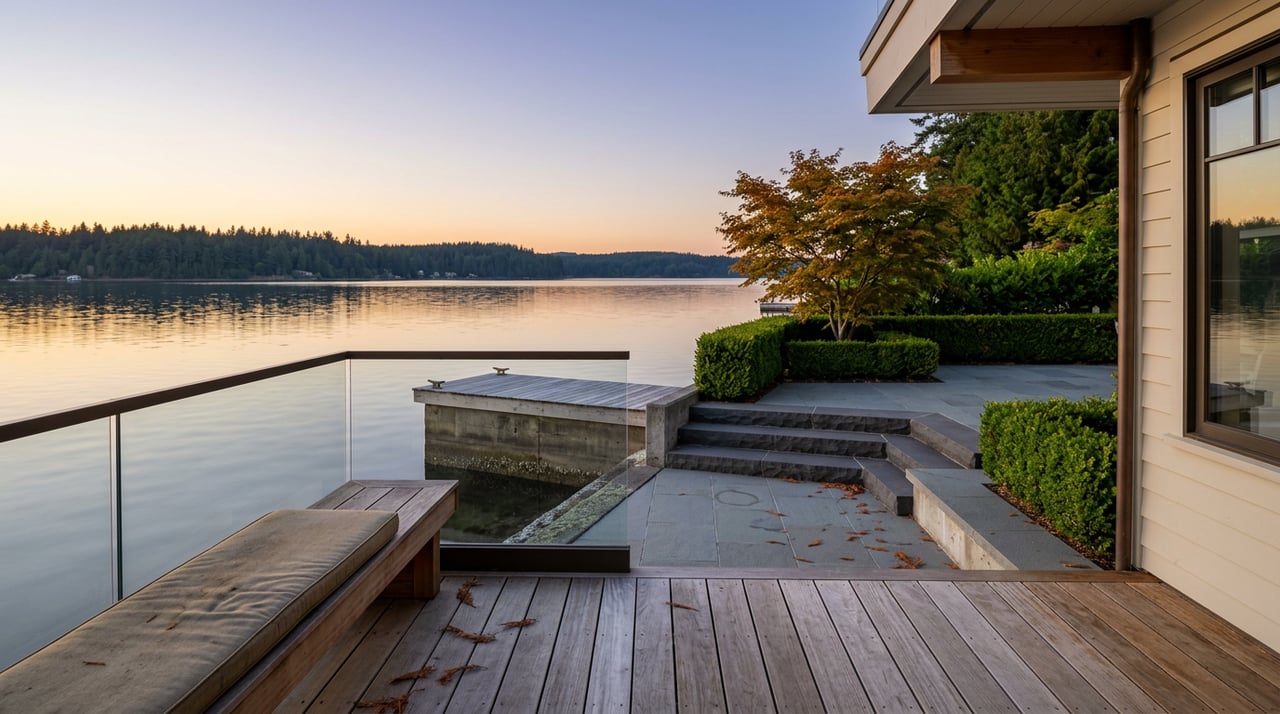
There is also a lifestyle difference underneath the numbers. Seattle's shore faces east, so mornings on the water in Madison Park or Denny-Blaine mean sunrise light and a straight-on view of the Bellevue skyline and the Cascades beyond it. The Eastside's shore faces west, so evenings on the water in Yarrow Point mean sunset over the Olympics and the Seattle skyline lighting up across the lake.
Laurelhurst, tucked on the Seattle side just south of the Windermere neighborhood, still carries the feel of the original suburb it was before Seattle annexed it: private beach club, tennis court, docks built with enough depth for a boat lift or a seaplane. Buyers drawn to that texture aren't comparing square footage against Medina. They're choosing a different kind of ownership entirely, one where the lake is a lived-in amenity inside a walkable neighborhood rather than the defining feature of an estate lot.
What This Means If You're Weighing Both Shores
The 2 Line makes the drive question mostly obsolete for buyers who work near a station on either side. It does nothing for the two questions that actually set the price: which school district your address sits in, and which municipal code governs what you can build on your own shoreline. A buyer choosing between a Denny-Blaine estate and a Yarrow Point waterfront lot isn't really choosing a commute anymore. They're choosing between Seattle Public Schools and Bellevue School District, and between a shoreline governed by Seattle's code and one governed by unincorporated King County's.
Those differences add another dimension to the comparison.
A Few Questions Worth Asking Directly
Will the price gap close as more people use the 2 Line? Five months of ridership hasn't moved it, and the mechanisms holding it up, school zoning and shoreline code, don't respond to transit ridership at all. Expect the gap to track school-district and permitting policy changes before it tracks train schedules.
Should I pick a shore based on which one has the shorter drive now that rail exists? Only if commute was your sole constraint to begin with. If school assignment or shoreline development flexibility matter, those variables outweigh a five-minute difference in transit time.
Is Yarrow Point actually a better value than Medina, or just cheaper? Both, depending on what you're buying it for. The regulatory flexibility that keeps Yarrow Point's prices lower also means less certainty about what a neighbor might build next door. Medina's tighter code cuts both ways: slower for you, but slower for everyone else too.
Comparing shores on paper only gets a buyer partway there. The rest depends on knowing which code, which district, and which lot actually fits the life you're trying to build on the water. If you're weighing Seattle's lakefront against the Eastside's, or trying to understand what a specific Yarrow Point, Medina, or Clyde Hill address is really worth right now, Whittlesey Properties has spent 40 years on this side of the lake and can walk you through what the numbers don't show. Schedule a consultation whenever you're ready to look past the median.
This article is general information, not legal, tax or financial advice. Consult a qualified professional about your situation.