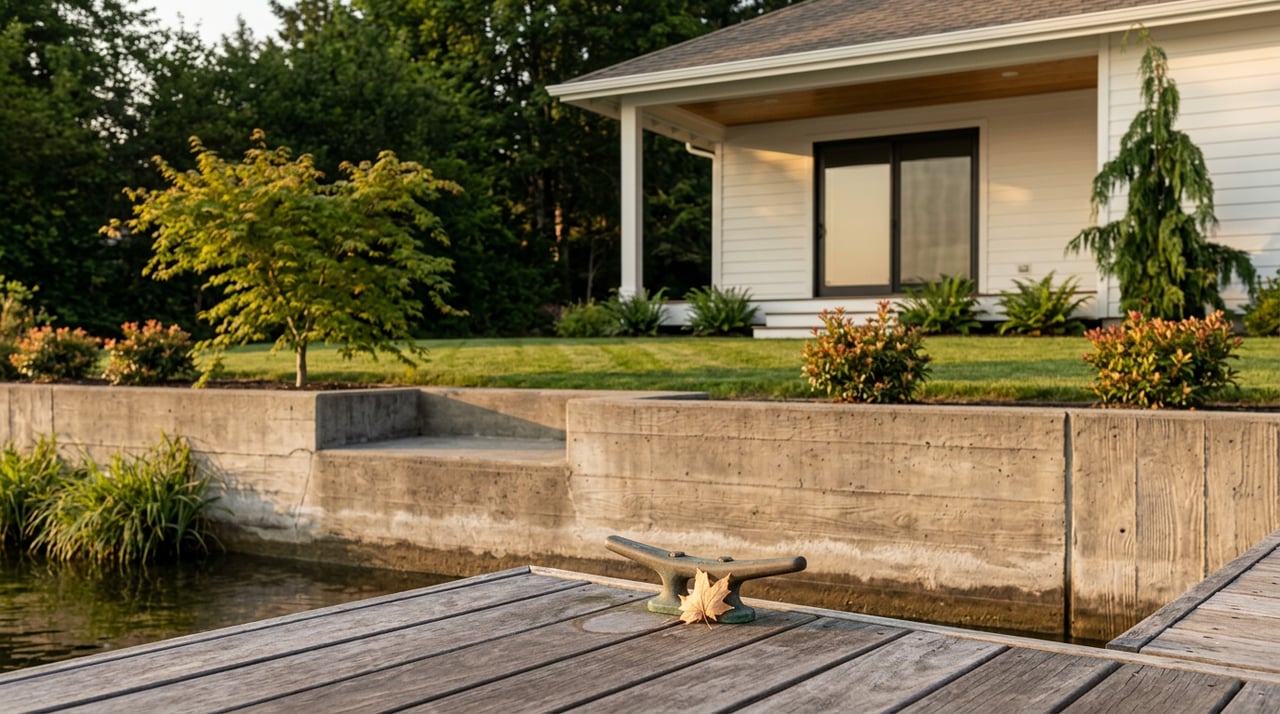
In May of 2025, an owner on 95th Avenue NE filed an application with Yarrow Point Town Hall to retrofit four jet ski lifts, replace two canopy covers, splice and repair some pilings, and fix an existing boat lift. It is the kind of project most waterfront owners on Lake Washington would expect to wrap up in a season. The Town did not deem the application complete until April 26, 2026. A public hearing before the Town Council was not scheduled until May 27, 2026, more than a year after the paperwork was first submitted.
That gap is not a fluke. It is the clearest evidence of something most sellers do not learn until they are already in escrow: Yarrow Point is its own incorporated town, and its shoreline permitting runs on a calendar that has nothing to do with King County, Bellevue, or the rest of the Eastside.
Why the Clock Runs Differently Here
Yarrow Point was incorporated in June 1959, largely to preserve its character as the region grew up around it. It covers about 231 acres, has 4.32 miles of streets, and is home to roughly 1,135 residents across 405 houses, a quarter of which sit directly on the water. That is a small enough footprint that the Town runs its own Building Department, its own Town Planner, and its own Town Engineer, separate from the King County Shoreline Master Program that governs most of the rest of Lake Washington's shoreline.
Small size cuts both ways. A tight-knit town government means a resident can usually reach the Building Official directly. It also means there is no bench of staff to absorb a surge in applications, and the Town Council itself does not meet every month. This August, for instance, there is no Town Council meeting at all. When a shoreline application needs a Council hearing rather than an administrative sign-off, the review has to wait for a seat at a table that convenes on its own schedule, not the applicant's.
The Two Permits That Decide Your Timeline
The Town has a shoreline jurisdiction, and almost everything a waterfront owner might want to do to a dock or bulkhead lands in one of two buckets.
| Permit type | Who decides | What triggers it |
|---|---|---|
| Shoreline Exemption Permit | Issued administratively by Town staff | Renovations, remodels, or additions that fall under the state's exemption thresholds |
| Shoreline Substantial Development Permit | Requires a public hearing before the Town Council | New construction with more than 250 cubic yards of grading outside the home's footprint, or larger shoreline projects like the jet ski lift retrofit above |
The exemption path can move at the pace of Town staff availability. The substantial development path adds a Council hearing, which is exactly the sequence that stretched the 95th Avenue project past a year. Projects valued over $50,000 also require a mandatory pre-application conference with the Building Official, Planner, and Engineer before an application is even accepted, a step meant to catch problems early but one more meeting to schedule on a small town's calendar.
The Cross-Jurisdiction Quirks Nobody Mentions Until Closing
Because Yarrow Point is so small, it leans on its neighbors for services it does not staff itself, and those handoffs create friction points that surface during due diligence rather than at listing.
The Town of Yarrow Point's building permit package says fire sprinkler plans are reviewed by the Bellevue Fire Department before the Town issues the actual permit, even though Yarrow Point has no formal relationship with Bellevue's government otherwise. The Town's Shoreline Permit Application says traffic control and parking plans for any construction project are reviewed by the Yarrow Point Building Official and then forwarded to the Clyde Hill Police Department, which is the agency that actually issues tickets for violations. And the Town's rule on construction parking is absolute: no vehicles are permitted on any street shoulder anywhere in Yarrow Point, a detail that has tripped up more than one contractor mid-project.
None of this shows up on a listing sheet. It shows up when a buyer's contractor tries to schedule a remodel after closing and discovers the review path runs through three different departments in two different towns.
What Thin Inventory Does to the Numbers
As of August 12, 2026, there were 8 homes for sale in Yarrow Point, with a median asking price of $5,899,000 and a median size of 5,788 square feet, which works out to roughly $1,019 per square foot. That is the entire active market on a 231-acre peninsula.
The closed-sale data tells an even more pointed story about how little volume there is to work with. The median sale price for homes that closed in July 2026 was $4,094,000, down 7 percent from July 2025's $4,412,500, with just two closings recorded in each of those months. Zoom out to April 2026 and the median sale price was $7,500,000, while July's figure was about 45 percent lower. May 2026 recorded zero closed sales at all, though one home went under contract that month, which is arguably the more useful signal.
This is not a market correcting itself month to month. It is a handful of individual transactions, and each one carries outsized weight in the data simply because there are so few of them. When a Yarrow Point home is priced accurately and its permit history is clean, it tends to move fast: the median time on market has run about 5 days, with sellers realizing roughly 97.7 percent of their original asking price. The properties that stall are usually the ones where a buyer's inspection turns up a question the seller cannot answer on the spot, whether that is a dock repair done without a permit or a bulkhead modification with no paper trail at Town Hall.
What This Means If You Are Preparing to List
If you are planning to update a dock, repair a bulkhead, or otherwise touch the shoreline before you list, the math above suggests starting that process well before you plan to put a sign in the yard, not after you have already lined up a closing date. A Shoreline Substantial Development Permit alone can take the better part of a year to reach a hearing, and that clock starts on the day the Town deems your application complete, not the day you submit it.
If you are not planning new work, the more immediate task is simply knowing what is already on file. A dock, boat lift, or bulkhead that was built or modified without Town sign-off is exactly the kind of detail a buyer's inspector or title company will ask about. Pulling the Town's permit history before you list, rather than after an offer comes in, keeps that conversation on your terms.
Given how thin the transaction volume is here, a listing agent's value in Yarrow Point has less to do with chasing a trend line that barely exists and more to do with knowing which permits are clean, which are pending, and how long the Town's process actually takes before a buyer's financing timeline collides with it.
A Few Questions Worth Answering Directly
Does Yarrow Point route building permits through King County? No. The Town of Yarrow Point issues its own building, mechanical, plumbing, demolition, and shoreline permits through its own Town Hall, separate from King County's process that applies elsewhere on the lake.
How much time should I budget for shoreline work before listing? Plan conservatively. The documented case above ran from a May 2025 application to an April 2026 completeness finding, with a Council hearing still a month out after that. If your renovation timeline depends on shoreline work finishing before a certain listing date, start the application well over a year ahead if a Council hearing is likely.
Is Yarrow Point currently a buyer's or seller's market? With only 8 active listings as of mid-August 2026 and homes that are priced correctly selling in about 5 days at close to full ask, well-prepared listings are moving on the seller's terms. The volatility in the median sale price from month to month reflects the small number of transactions, not a shift in underlying demand.
What should I know about past shoreline work that was never permitted? Permit status on structures like docks and bulkheads is a common area of buyer scrutiny during inspection and title review. If you are unsure what is or is not on file with the Town, it is worth checking before you list rather than during an active transaction. This is general information, not legal advice, and a real estate attorney can speak to your specific situation.
Yarrow Point's size is part of what makes it desirable. It is also exactly why its permitting process behaves differently than anywhere else on the lake. If you are weighing a sale, or a shoreline project ahead of one, the team at Whittlesey Properties has spent decades working inside these small-town processes on the Eastside's Points communities. Schedule a consultation before you file the first form, not after the Town asks for a second one.